
The Computational Model
One variable changes. Every number downstream recalculates.
The Methvin Global Variables methodology turns a feasibility budget into a live, connected model — not a spreadsheet snapshot frozen the moment it’s printed.
Executive Summary
Construction estimating has traditionally been a static process. Quantities are measured, rates are applied, and totals are calculated independently. This approach can produce accurate estimates, but it becomes difficult to manage once a project grows in scale and interdependency: evaluating an alternative structural system, a revised floor count, or a different site configuration often means extensive manual recalculation, or an entirely separate estimate built from scratch.
Methvin’s Global Variables (GV) methodology replaces this fragmented approach with a deterministic computational model.
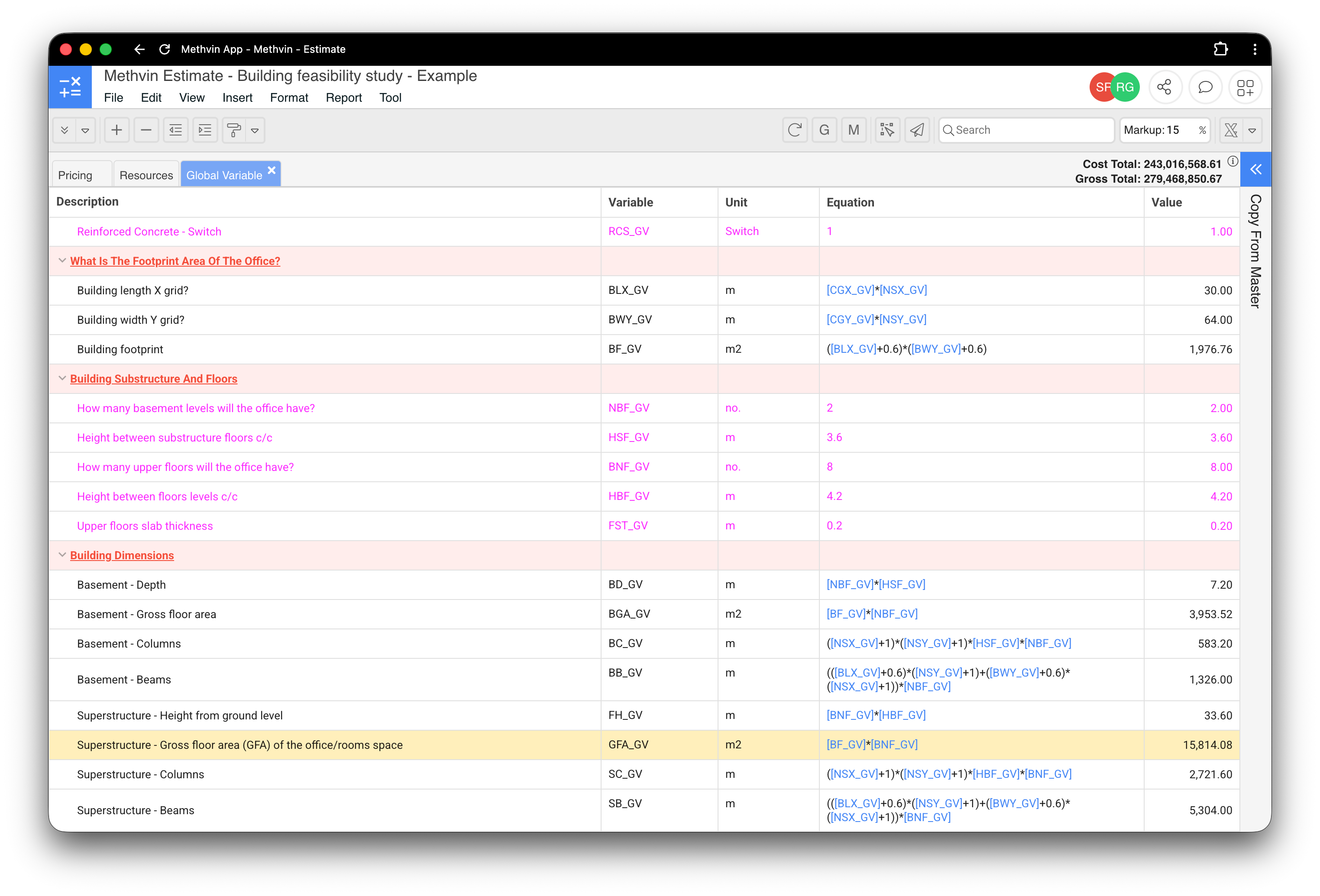
At the core of the methodology is a dependency graph. Every project variable, formula, resource, and bill item becomes a node in a connected computational network, rather than an isolated calculation. A defined set of parameters, including site geometry, building form, structural system, programme assumptions, and financial settings, drives formulas that generate building quantities, a construction programme, professional fee estimates, and a resource-based cost plan, typically 500 or more individually traceable line items on a single project. The underlying dependency architecture has no fixed limit on that count: some users run live estimates with 50,000 or more records, all resolved through Global Variables. Every one of those calculated values maintains a direct mathematical relationship to the variables that define it.
A change to any project parameter, such as floor count, structural system, floor-to-floor height, or contingency percentage, is automatically propagated throughout the model. Every dependent quantity, duration, resource requirement, and project cost recalculates within the same working session, without manual intervention, regardless of whether the model holds 500 records or 50,000.
Unlike a manually built spreadsheet, where dependencies are frequently duplicated, hidden, or maintained by memory, Methvin preserves complete computational traceability at any scale. Each line item can be traced from a total cost, through the resource and quantity behind it, back to the formula and Global Variable that generated it. This reverse path is what makes the model auditable rather than simply automated, and it is what allows a client, financier, or design partner to interrogate a specific figure rather than accept a headline number on trust.
Because the model is computational rather than static, alternative project configurations can be evaluated within the same estimating environment. A concrete frame can be tested against a structural steel alternative, or an additional floor tested against a fixed budget, with cost, programme, and fees updating together, rather than requiring a separately built estimate for each option.
This capability is entirely deterministic. Every result is produced from defined variables, formulas, and repeatable computational logic, not a probabilistic or opaque process. Artificial intelligence is not responsible for performing these calculations. Where AI is incorporated within Methvin, its role is to assist users in generating scenarios or interpreting information, while the computational engine remains fully transparent, auditable, and mathematically explainable.
The chapters that follow explain what a Global Variable is and how the dependency chain turns one into a cost, how this differs from conventional takeoff and benchmark-based estimating, how the resource-based cost build-up is substantiated, and where the appropriate limits of the methodology sit.
The Problem
Understand why early-stage feasibility budgets are high-stakes and hard to revise — and who the Global Variables methodology is built for across development, finance, QS, design, and project management.
The Architecture
Explore what a Global Variable is, how a connected project model derives geometry, structure, services, programme, and fees, and the dependency chain that turns a variable into a cost.
Proof in Practice
See how the methodology differs from conventional takeoff and benchmarking, how resource-based cost substantiation works, and how scenario comparison and programme integration stay consistent.
Conclusion & Limitations
Review the commercial case, development and validation approach, appropriate-use limits, and an illustrative resource build-up extract from the model.
Addendum: US Formwork
A worked US customary example: Concrete Formwork, Walls priced from linked materials and consumables resources, in square feet, linear feet, and board feet.
Addendum: Pipe to Payroll
A five-resource metric chain from a 450mm RCRRJ supply-and-install rate down through crew, excavator, operator, and labour living-out allowance.